Return to Wahhoga
50+ years after the last Tribal village in Yosemite was intentionally destroyed, the Southern Sierra Miwuk Nation reclaims a piece of home with the return of the village’s last remaining cabin.
by Zoe Duerksen-Salm, Yosemite Conservancy Content Manager

On a crisp May morning in 2023, a wooden cabin makes its way slowly through Yosemite Valley, perched atop a tractor trailer. Its windows are weathered by time, and its floorboards slant from prior relocations. But the cabin never left the Valley and was never forgotten by the people who once called it home.
Just west of what is now Camp 4, the cabin is carefully placed on a foundation that has long awaited the return — not only of the cabin, but of its people.
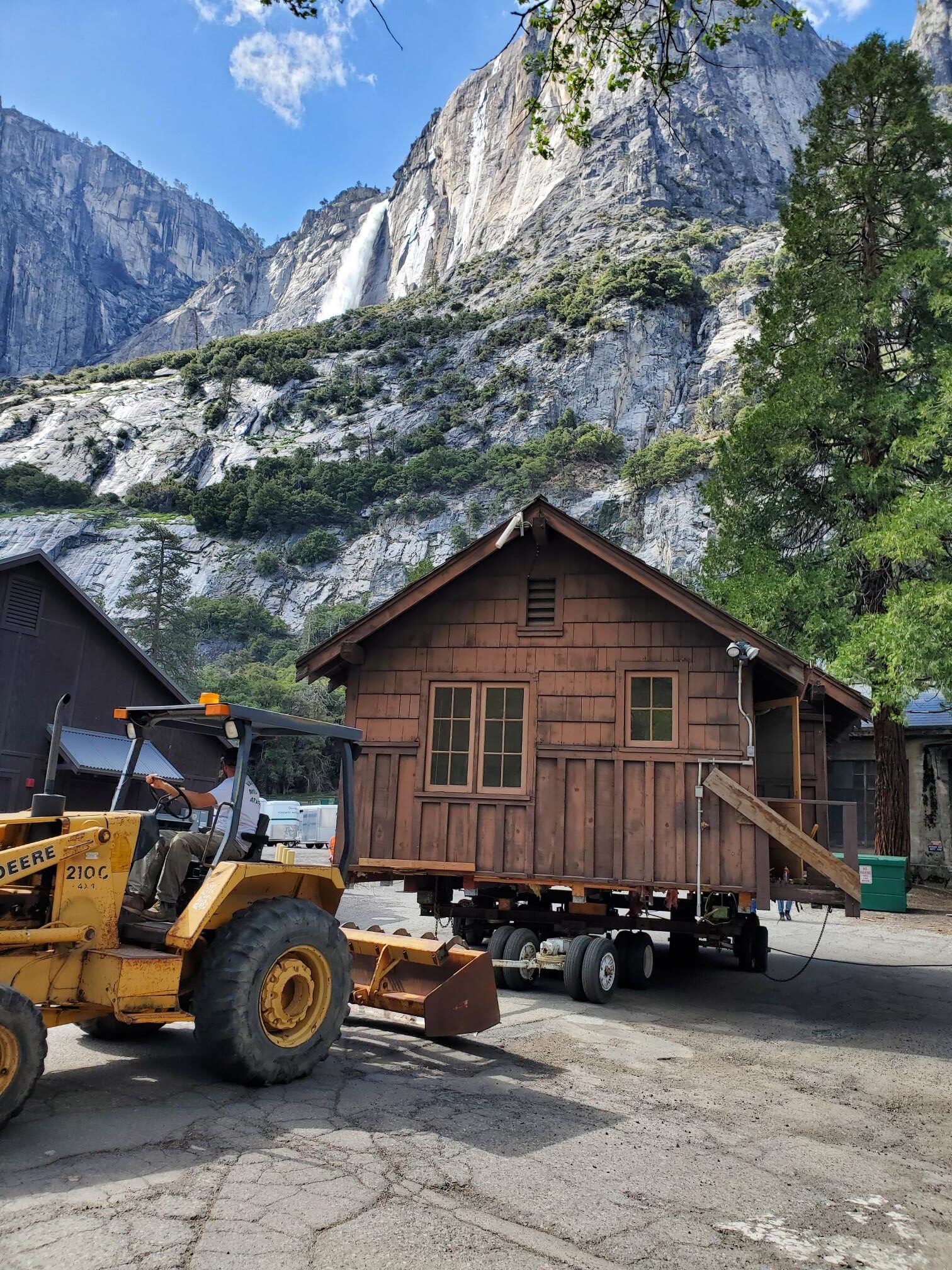
The Wilson Cabin being pulled through Yosemite Valley to be returned to its home in the ancestral site of Wahhoga. Photo courtesy of NPS.
For thousands of years, Native people have lived in and cared for the land now known as Yosemite National Park. They’ve raised children, built homes, harvested food, managed landscapes, and held ceremonies.
In time, however, that relationship was forcefully disrupted by the arrival of settlers: gold-seekers, ranchers, state-sponsored militia, explorers, tourism prospectors, and others.
“Tribes across California’s desirable landscapes were decimated by approximately 90% through massacre, relocation, disease, and resource starving,” says Echo Davenport, supervisory archeologist and Tribal liaison at Yosemite National Park.
The designation of Yosemite National Park intensified and formalized these waves of displacement. In 1906, the U.S. Army seized the village of Koom-i-ne to make way for park headquarters in Yosemite Valley. Displaced park and concessioner employees of Native descent established a village — now known as the “Old Village” — with their families in the current location of the Yosemite Medical Clinic, adjacent to Ahwahnee Way.
Less than three decades later, the people were displaced again following the construction of the Ahwahnee Hotel, this time to the “New Village” built on the ancestral site of Wahhoga.
Fifteen wood cabins were built by the National Park Service (NPS) here in Wahhoga. Families of park employees of various Tribal descent, predominantly Miwuk and Mono-Paiute, lived at the New Village but were required to pay rent. Still, the people remained deeply connected to their traditions and culture. They held ceremonies. They stewarded the land. They raised families. They lived in community for more than 30 years.
In the 1960s, however, a growing tourism industry led to the re-envisioning of land use in Yosemite Valley and the NPS decision to expel Native residents from Wahhoga altogether. For reasons still not fully explained, Wahhoga’s wood cabins were burned down in a fire-training exercise with belongings inside. With no other option, families were forced to leave.
“There are people alive today who were there in 1969 and saw their family’s homes burned to the ground,” Davenport says.
Only one of those structures was spared — the Wilson Cabin — and was relocated within the Valley for government purposes.
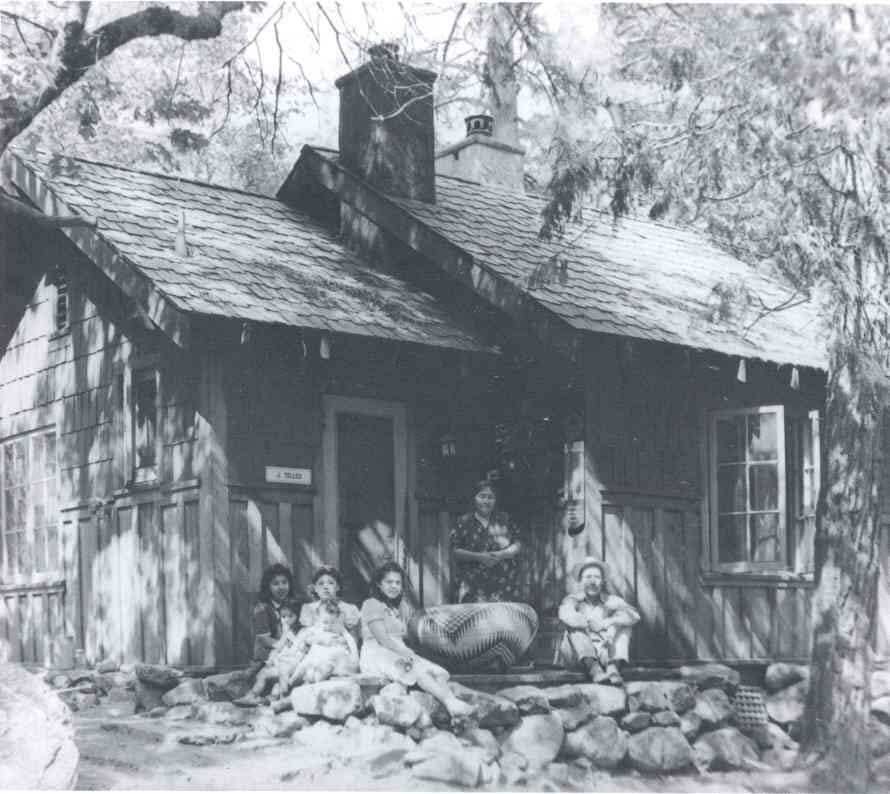
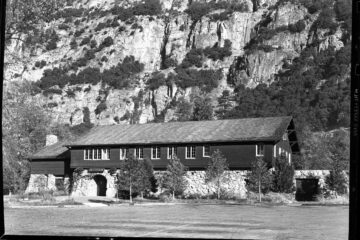
The Telles family in front of their home in the New Village before it was burned down. The cabin is built in the same style as the Wilson Cabin. Photo courtesy of NPS.
Provoked by the burning of Wahhoga, Les James and Jay Johnson of the Southern Sierra Miwuk Nation formed the American Indian Council of Mariposa County in 1972 to give a collective voice to their people.
“Everyone has their own stories, but to have one powerful voice, that’s what has sustained us,” says Sandra Chapman, chairwoman of the Southern Sierra Miwuk Nation. “Our elders stood before the park service and asked for the last cabin back, for the last village of Wahhoga to be given back to us.”
While Yosemite cycled through a dozen superintendents over the next five decades — Chapman herself has worked with seven — Tribal leadership remained consistent.
“The Tribes have always been here and have remained resilient and committed,” Davenport says. “It is because of this continuous presence that the vision of stewardship, education, and healing in Wahhoga has persisted and is finally coming to fruition.”
Slowly but surely, the vision came to life. The plan for an Indian Cultural Center at Wahhoga was included in the 1980 Yosemite General Management Plan. Ground was broken in 2009. The Wahhoga Committee was established in 2010 to uphold cultural and spiritual practices at the ancestral site. A cooperative agreement was signed in 2018, granting the American Indian Council of Mariposa County authority to oversee the ongoing operations and maintenance at Wahhoga. Construction of the ceremonial roundhouse was finalized in early 2023, marking the return of ceremony to Wahhoga.
And on that spring morning in 2023, the Wilson Cabin came home.
“To know that the cabin’s return could happen in my lifetime — and in the lifetime of some of our elders — it was like a dream,” Chapman says.
That dream did not happen overnight. It took decades of advocacy, the persistence of the Wahhoga Committee, and collaboration with park leadership. For years, elders Johnson and James worked diligently with park superintendents to champion the return of Wahhoga. Johnson and James did not live to see roundhouse completed, the Wilson Cabin returned, or the still-awaited federal recognition of the Southern Sierra Miwuk Nation, but their influence is felt today in every corner of Wahhoga and in continued relationships between Tribal leaders and the NPS.
Chapman notes that one of the many things James and Johnson taught her was, while the trauma of her people should never be forgotten, those in the NPS responsible for past harms are not the same people working for the park today.
“We can’t keep dwelling on the bad history,” Chapman says. “There is good history there, too. We got our Wilson Cabin back. We built our roundhouse. We have ceremonies there now. We must work together with the park service, instead of working against each other.”
Collaboration was front and center in the Wilson Cabin’s restoration following its return. In 2025, the park’s Historic Preservation Team performed a full rehabilitation of the building, funded by Conservancy donors. They stabilized the foundation, added a stone skirt, rebuilt the roof, repaired windows, fabricated screens, repaired exterior siding, and rebuilt the welcoming front porch — all while preserving as much original material as possible and ensuring historical accuracy.
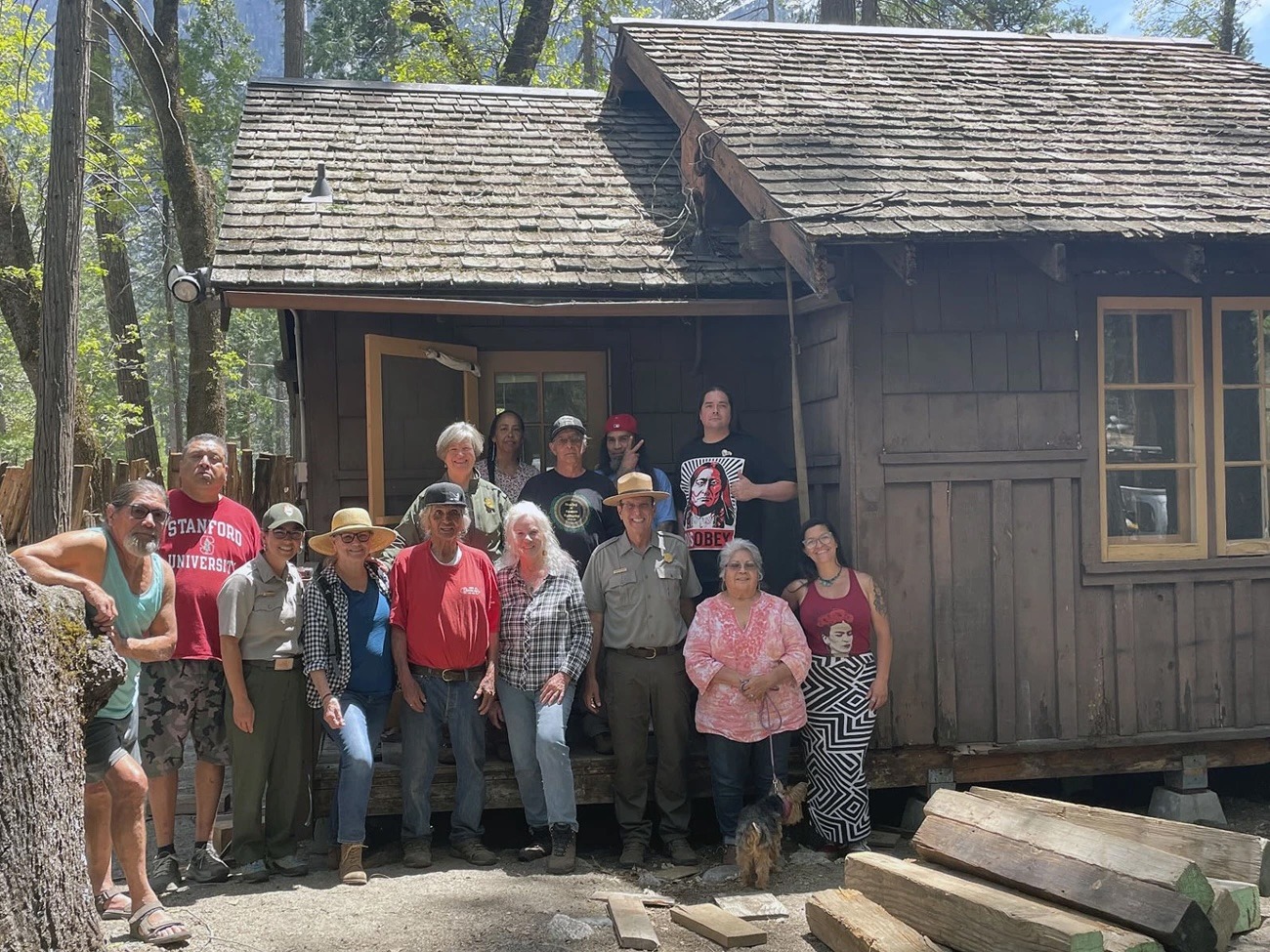
Members of the Wahhoga Committee, Southern Sierra Miwuk Nation, and National Park Service employees pose in front of the returned Wilson Cabin. Photo courtesy of NPS.
“The cabin holds the family’s history of walking on those floors and touching those walls; you don’t want to replace that,” says Kevin Brothers, Historic Preservation Team lead. “Our goal is to revitalize buildings as close to what they were at the time of construction.”
In harmony with the Wahhoga Committee’s vision of education and stewardship, two Tribal interns were hired to assist in the restoration: Joseph Long and Shawnya Peterson.
“It felt so accomplishing to be a part of it,” says Long, who is also the fourth great-nephew of Alice Wilson, one of the cabin’s original residents. “It felt like helping out your grandma. Even working there, I could feel the energy of my people just hanging out with me.”
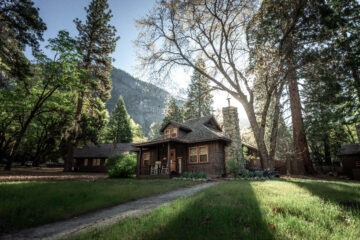
Today, the Wilson Cabin stands quietly in Wahhoga, so seamlessly settled into place that you might think it never left. But it holds the history of removal, fire, relocation, and return within its walls. The cabin has endured displacement, repurposing, and decades of waiting. So, too, have the Native peoples of Yosemite.
For the Southern Sierra Miwuk Nation, the village provides something that has been absent for decades: a sustained, year-round presence in Yosemite Valley. It offers space for ceremony, language revitalization, youth education, and welcoming people from all Tribes to benefit from this spiritual place that holds deep significance to Native people.
The Wilson Cabin’s return is not the end of the story; it is one step toward embracing Wahhoga as a place of remembrance, renewal, and the enduring vibrance of Tribal culture. The village and its people stand not untouched by history but strengthened by survival. Still here. Wahhoga finally returned.
This article was originally published in our Spring/Summer 2026 magazine. Read the full magazine issue here.