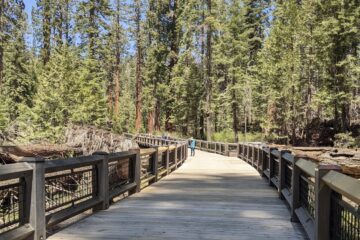


NPS forest ecologist Garrett Dickman and Ancient Forest Society climber Erin Burk at the top of the Grizzly Giant during a health inspection in June 2026. // Wendy Baxter @wendyupatree
Bark Beetles, Fire Suppression, and Tribal Wisdom: Why the Grizzly Giant’s Health Check Matters in 2026
On June 17, a crew from the Ancient Forest Society clipped into ropes and climbed into the canopy of the Grizzly Giant — one of the largest sequoias in Mariposa Grove — to give one of Yosemite’s most iconic trees a physical. They checked the same three things researchers now look for on sequoias across the Sierra Nevada: overall canopy health, water status, and signs of bark beetle activity. After the ropes came down, the verdict was good news: the Grizzly Giant is healthy.
This health inspection represents a critical frontier in giant sequoia conservation research. Using rope-climbing techniques pioneered by the Ancient Forest Society, researchers monitor three vital indicators: canopy health, water stress in trees, and signs of beetle infestation. These sequoia health assessments are becoming standard practice across the Sierra Nevada as climate change and historic fire suppression threaten these ancient giants.
For a tree that’s been standing for roughly 3,000 years and facing new environmental stressors, that’s not a small thing to confirm.
Why the checkup matters
These climbs aren’t just for show. Sequoias are facing real, compounding pressure right now — wildfire, drought, and bark beetles among them — and the only way to know how an individual tree is holding up is to get eyes (and instruments) directly into its crown.
The Ancient Forest Society has used this same protocol on other giants, including a high-profile 2024 health check of General Sherman, the largest tree on Earth. Beetle activity, in particular, has become something researchers are watching closely: recent surveys found signs of a cedar bark beetle called Phloeosinus punctatus in around 90% of mature sequoias surveyed across 12 groves.
A clean bill of health on the Grizzly Giant, then, isn’t a given. It’s a sign the tree — and the grove around it — is holding up.
That matters because beetles and drought stress tend to be symptoms of a bigger problem, not the root cause of it. A sequoia weakened by decades of fire suppression and overcrowded, fuel-choked groves is far more vulnerable to both. The healthiest path forward, researchers increasingly agree, runs through restoring the conditions sequoias evolved for in the first place — including regular, low-intensity fire.
A tree, and a relationship, worth checking on
Yosemite forest ecologist Garrett Dickman was on hand for the climb, and at one point did some quick math out loud: at roughly 75 years per human lifespan, the Grizzly Giant has now outlasted about 40 generations of people. Forty generations who’ve stood next to the same tree, witnessing chapters of its life from sapling to maturity
He was talking with Irene Vasquez, a Southern Sierra Miwuk Tribal member and cultural ecologist, about exactly that — what it means to care for something across a timescale most of us can barely picture.
“It’s fun to think about that,” Vasquez says, imagining her own ancestors moving through these same groves long before her, “and how beautiful it must’ve been, and that relationship of living within and among them.”
That relationship is also the reason the Grizzly Giant’s good checkup feels like more than routine maintenance.
Tribal communities tended these groves with fire for thousands of years before that practice was suppressed for the better part of a century — a mismatch researchers now understand contributed directly to the high-severity wildfires that have killed an alarming share of the sequoia population in the last decade. Restoring fire to these groves and restoring Tribal leadership in how that fire is used, is widely considered the clearest path to keeping trees like the Grizzly Giant standing for centuries to come.
You can watch Dickman, Vasquez, and Anthony Ambrose, cofounder and executive director of Ancient Forest Society, talk through all of this — generations, fire, and what a sequoia checkup is really telling us — in a short video filmed the same day as the climb. And you can read the full health inspection here.
Forty generations, one healthy tree
The Grizzly Giant has outlasted droughts, fires, and 40 generations of people who depended on it being there. The climb on June 17 is a small but real piece of evidence that the work being done right now, by scientists and Tribal stewards alike, is helping keep it that way for the 41st.
FAQs
Q: What is the Grizzly Giant sequoia?
A: The Grizzly Giant is one of the largest giant sequoias in the world, located in Mariposa Grove in Yosemite. At approximately 3,000 years old, it has survived countless droughts, fires, and more than 40 generations of human visitors. Despite its massive size (over 209 feet tall), it remains vulnerable to modern threats like beetle infestations and climate stress.
Q: Why do scientists climb giant sequoias to check their health?
A: Getting high into the canopy allows researchers to directly observe three critical indicators: overall canopy health, water stress in the tree’s branches, and signs of bark beetle activity. Ground-level inspections can’t detect these early warning signs. The climbing protocol, pioneered by the Ancient Forest Society, has become the gold standard for monitoring California’s most valuable trees.
Q: What’s been killing giant sequoias in California recently?
A: Giant sequoias face a “perfect storm” of threats:
- Bark beetles (Phloeosinus punctatus) – Found in ~90% of mature sequoias surveyed
- Drought stress – Climate change is reducing water availability
- High-severity wildfires – Catastrophic burns have killed unprecedented numbers of sequoias in the past decade
- Fire suppression legacy – A century of suppressing all fire created dense, fuel-choked groves vulnerable to megafires
Q: Wait—don’t sequoias need to be protected from fire?
A: This is a common misconception. Giant sequoias co-evolved with fire for over 3,000 years. Low-intensity, frequent burns actually benefit sequoias by:
- Reducing competing vegetation
- Clearing dangerous fuel buildup
- Promoting sequoia reproduction
- Preventing the catastrophic megafires that now threaten entire groves
The problem isn’t fire itself—it’s the absence of the right kind of fire for a century.
Q: What’s the connection between Tribal stewardship and sequoia health?
A: Southern Sierra Miwuk communities and other Tribes tended groves with intentional, low-intensity fire for thousands of years before the practice was suppressed in the early 1900s. This traditional ecological knowledge directly enhanced sequoia resilience. Restoring Tribal leadership in fire management is now recognized as essential to protecting these ancient forests. The Grizzly Giant’s good health is evidence that restoring these practices works. (Read about how Little Fires are making a big difference in Yosemite.)
Q: What happens during a sequoia health inspection climb?
A: Expert climbers from organizations like the Ancient Forest Society use ropes to safely ascend into the sequoia’s crown (canopy). Once at the top, they:
- Visually assess overall canopy health and needle color
- Measure water status using specialized instruments
- Look for signs of beetle damage or tunneling in bark
- Document findings for research
The entire process takes several hours and provides data that can’t be gathered from the ground.
Q: If the Grizzly Giant is healthy now, is the problem solved?
A: One healthy tree is great news, but it’s not the whole story. The Grizzly Giant’s good health reflects successful ongoing conservation work. However, many other sequoias remain threatened. Long-term protection requires:
- Restoring fire to sequoia groves
- Continuing research and monitoring
- Expanding Tribal fire stewardship programs
- Addressing climate change impacts
The climb is routine maintenance on a tree we’re actively protecting—not a sign the crisis has passed.